The Radical History of Community Acupuncture
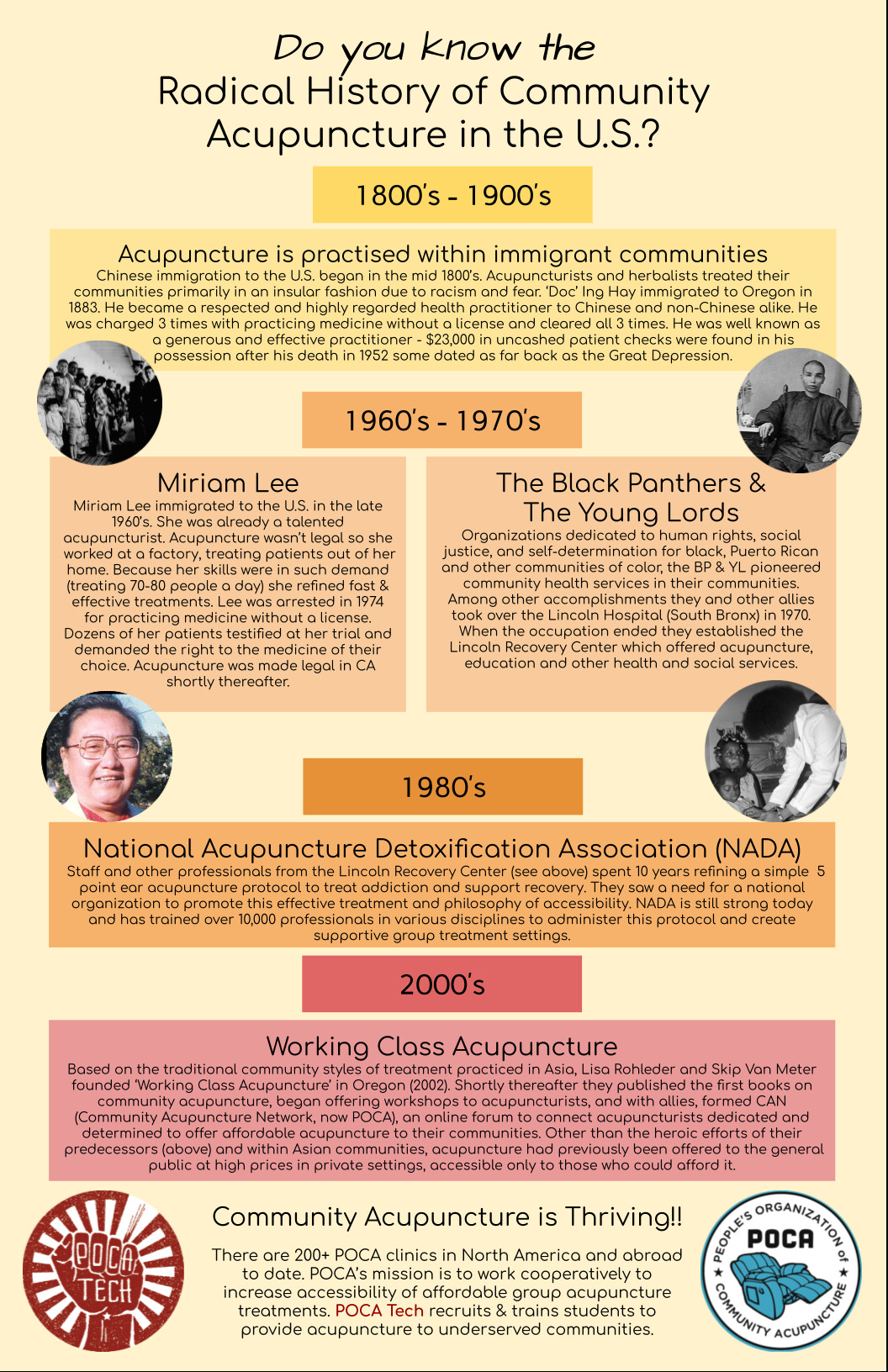
Community Acupuncture has a rich history full of brave, stubborn, deeply dedicated activist-practitioners like Miriam Lee and the Black Panthers and Young Lords at Lincoln Detox in New York who were steadfast in their determination to create healing for themselves and their communities. NADA and POCA are two fantastic organizations that promote the expansion of access to affordable acupuncture.
NADA is the National Acupuncture Detoxification Association. NADA trains acu-detox specialists in a simple, powerful acupuncture protocol so that more people can get acupuncture and so that trusted members of their community can be the ones giving it such as peers, mentors, teachers, social workers, etc.
POCA is The People's Organization of Community Acupuncture. POCA is a member-run 501(c)(6) non-profit organization whose mission is to work cooperatively to increase accessibility to and availability of affordable group acupuncture treatments. We envision a world in which every community has access to local, affordable acupuncture to reduce collective and individual suffering and nurture resilience. POCA has been supporting and growing community acupuncture since 2006 and has created a technical school for regular people to become acupuncturists and serve their community
Community Acupuncture would not be where it is today without the hard work and dedication of many POCA members. Community Acupuncture SoBu is a proud member of POCA and sustainer of ORCCA (Oregon College of Community Acupuncture formerly POCA Technical Institute.)
The History of Community Acupuncture in a Nutshell
Working Class Acupuncture
The community acupuncture movement owes a LOT to the folks at Working Class Acupuncture in Portland OR. The seeds they planted, and continue to plant, have flourished throughout the entire United States and even abroad.
They have even started a school, the Oregon College of Community Acupuncture, the only one of it's kind that trains folks specifically in community style and liberation acupuncture. Check out the short documentary below. It's interesting - we promise!
Lisa Rohleder and Skip Van founded Working Class Acupuncture 2.5 decades ago. They have been advocating for community acupuncture and supprting it's evolution ever since. Check out Lisa's substack, "Acupuncture Can Save the World". She is an amazing, informative, and entertaining author.
~Liberation Acupuncture Manifesto~
from Lisa Rohleder of Working Class Acupuncture
~ Because acupuncture does not have to be expensive in order to be effective
~ Because military budgets balloon while health care is cut
~ Because nothing breaks through the isolation of pain, illness and depression like healing in a room with other humans
~ Because our favorite way to spread the word about how well acupuncture works is to make it available to people
~ Because we are pleased to challenge the notion of value being attached to price
~ Because there aren't enough spaces where strangers switch off cell phones and slumber side by side
~ Because for thousands of years acupuncture has been practiced in groups
~ Because returning acupuncture to its roots makes us the happiest of humble radicals
~ Because the vast majority of us love our work so much we couldn't imagine doing anything else –
We are a part of the community acupuncture movement.
Community acupuncture is healthcare reform because...
It is inclusive.
It is low-tech and low-cost.
It is preventative.
It does not require the approval or the participation of Big Insurance.
It is easy to understand and easy to use.
It breaks down the isolation
It is radically transparent and radically simple.
And finally, because it does not need the government or anyone else to fund it.
Community acupuncture is truly a grassroots movement.
The Calmest Revolution Ever Staged
A community acupuncture documentary
Black Revolutionaries and Acupuncture
Eana Meng is a historian of medicine and a physician in training. Her research has traced the lesser known histories of the use of acupuncture by American activists (including those in the Black revolutionary movement) since the 1970s and the legacies that emerge from them, which include a five point ear acupuncture protocol currently used around the world for substance use and behavior health conditions. She is interested in the histories that sit at the intersection of radical politics of health, integrative/alternative healing modalities, community healthcare, the opioid crisis and pain, and crucial dimensions of race, gender, and class. She runs a blog at https://www.ofpartandparcel.com/.
Dope is Death
The story of how Dr. Mutulu Shakur, stepfather of Tupac Shakur, along with fellow Black Panthers and the Young Lords, combined community health with radical politics to create the first acupuncture detoxification program in America in 1973 - a visionary project eventually deemed too dangerous to exist. Full film available to stream on Amazon and iTunes.
Vermont Community Acupuncture Clinics
Click on the town to find the clinic there
Community acupuncture clinics throughout the United States
Special thanks to West Philly Community Acupuncture for making this awesome resource!
